Malawi’s fiscal position continues to deteriorate despite a higher revenue projection in the 2025/26 National Budget, with Treasury figures showing a widening gap between income and expenditure in the first five months of the fiscal year.
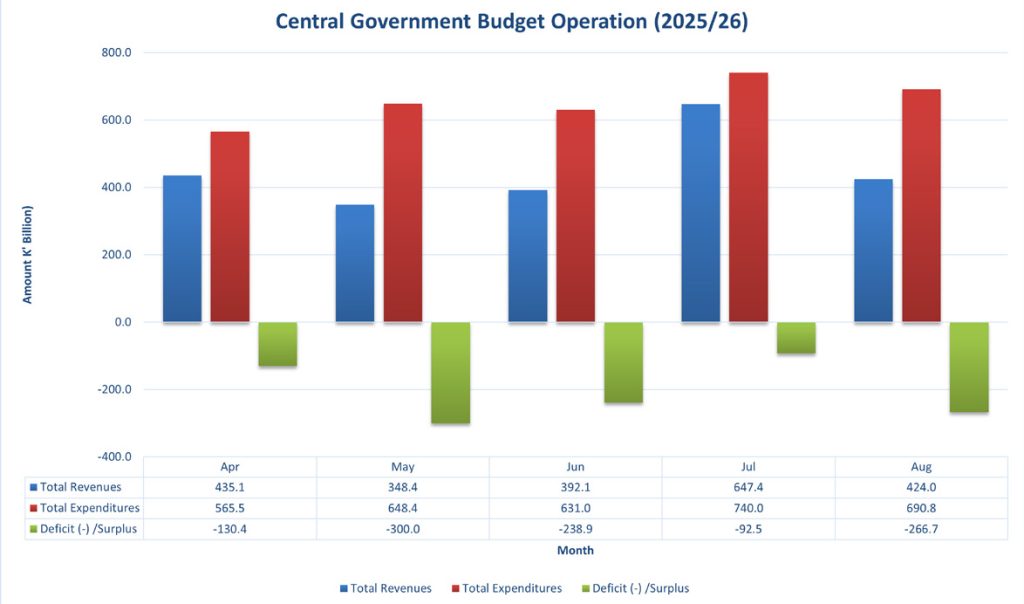
The outturns, covering April to August this year, show cumulative revenues at K2.25 trillion against expenditure at K3.28 trillion, creating a fiscal deficit of K1.03 trillion.
This, therefore, means that for every kwacha collected, the government spent about K1.46.
Treasury data indicates that revenues peaked in July at K647.4 billion before dropping to K424 billion in August, a 34 percent month-on-month decline. The weakest collection was recorded in May at K348 billion.
Meanwhile, expenditure has remained elevated, rising from K565.5 billion in April to K740 billion in July. The largest deficit was posted in May at K300 billion, compared to K92.5 billion in July and K266.7 billion in August.
Economists believe the pattern reflects the combined effects of election-related spending, weak revenue performance and structural rigidity in the budget that rolls out on April 1 and expected to end on March 31 2026.
Speaking in an interview yesterday, Mzuzu University economics lecturer Christopher Mbukwa said the widening gap was expected, given the pace of political expenditure.
He said: “There has been significant spending during the election season, which may have contributed to the deficit.
“The problem is not only the amount spent, but how little flexibility the government has to scale down once the cycle begins.”
Centre for Social Concern economic governance officer Agnes Nyirongo, in an interview, described the imbalance as “a systemic fiscal crisis that demands urgent attention,” linking the shortfall to election-period outlays and weak enforcement of spending limits.
“The five-month balance means the government is spending almost half more than it collects in revenue. That trajectory risks squeezing health, education and agriculture while raising borrowing pressure,” he said.
The approved 2025/26 National Budget set total expenditure at K8.05 trillion and, after appropriation, slightly raised total revenues and grants to K8.07 trillion, an almost balanced position on paper, according to economists.
But actual performance since April points to continuing volatility, with increased fiscal deficit over the months.
Monthly receipts remain unstable, grant inflows have softened and expenditure has consistently exceeded K565 billion, according to Treasury data.
In August, revenue fell sharply while spending stayed high at K690.8 billion, widening the gap nearly threefold from the previous month.
An economist who did not want to be named, in an interview yesterday, said three structural weaknesses lie behind the slippage, a narrow and cyclical revenue base, rigid recurrent commitments and post-election spending pressures that have eroded fiscal buffers.
He argued that restoring credibility will require tangible reforms in budget discipline and transparency.
“Weak controls during politically sensitive periods risk entrenching overruns that crowd out essential services and increase borrowing needs,” said the economist.
Scotland-based Malawian economist Velli Nyirongo cautioned that the widening gap could prompt the government to resort to more domestic borrowing, potentially leading to higher interest rates and worsening inflationary pressures.
He noted that the challenge now extends beyond balancing monthly books to rebuilding fiscal buffers and aligning recurrent spending with sustainable financing.
For policymakers, the near-term goal is to halt the slide that re-emerged in August without undermining service delivery.
This fiscal year’s budget projected a fiscal deficit of K2.47 trillion or 9.5 percent of the gross domestic product, which will be primarily financed through domestic borrowing amounting to K2.33 trillion and foreign borrowing of K145.78 billion, according to Treasury figures.